
Potential clients form an opinion about a website's visual appeal and trustworthiness in as little as 50 milliseconds, and the first 10 seconds are pivotal for whether they stay or leave. For photographers and creative professionals selling high-value services, this means a portfolio site cannot be a random grid of images; it must be a carefully engineered authority system that communicates expertise, reduces perceived risk, and moves visitors toward booking.
Modern Framer templates give creatives a powerful shortcut by combining fast performance, responsive layouts, and built-in SEO tooling with opinionated page structures designed for conversion. This article is a deep, practical guide to turning such an authority-focused Framer template-modeled on a strategic portrait and visual identity photographer's site-into a high-performing digital asset that attracts, convinces, and converts serious clients.
Quick Takeaways
- First impression window: visitors decide quickly whether your brand feels premium and safe to trust.
- Authority architecture: structure beats volume; each section must do a trust-building job.
- Conversion baseline: one primary CTA, fast load times, and low-friction navigation.
- SEO leverage: case studies plus educational content compound authority over time.
Why Authority Is The Real Product
Clients do not buy photographs, logos, or strategy decks in isolation; they buy the confidence that the creative they hire can reliably deliver in high-stakes situations. For corporate leaders, founders, and brands, working with the wrong creative partner risks wasted budget, incoherent identity, and missed commercial opportunities, so they subconsciously look for authority signals long before they look at pricing.
Search engines think in similar terms. Google's E-E-A-T framework (Experience, Expertise, Authoritativeness, Trustworthiness) emphasizes that sites demonstrating depth of knowledge, first-hand experience, and third-party recognition are more likely to rank for competitive queries. In practice, that means a creative portfolio that behaves like a serious expert resource-complete with case studies, educational content, and clear positioning-earns both human trust and algorithmic trust.
The Psychology of First Impressions Online
Multiple UX and cognitive psychology studies show that users form reliable judgements about a website's aesthetics within 50 milliseconds, and these first impressions strongly influence willingness to continue using the site. Because humans process images tens of thousands of times faster than text, layout, color, and imagery are perceived before any copy can explain or justify them.
For creatives, this has two implications:
- The hero section is a psychological handshake: it instantly signals whether the site is premium, coherent, and relevant to the visitor's needs.
- Visual noise, cluttered navigation, or dated styling can silently communicate unreliable or low-end quality even if the work itself is strong, increasing bounce rates and killing inquiries.
An authority-driven Framer template therefore front-loads clarity and polish: a bold promise, focused layout, and crisp typography that feel intentional from the first frame.
From Gallery Dump to Authority Architecture
Most photographer and creative websites fail not because the images are bad, but because the overall information architecture is random: galleries are unstructured, services are vague, and there is little proof of performance. An authority-oriented template treats the website as visual architecture rather than a scrapbook, organizing every section to do a specific trust-building job.
A typical authority layout includes:
- Hero section that articulates a sharp value proposition.
- Solutions and capabilities section that frames services as outcomes.
- Trusted by logos and quantified proof.
- Narrative case studies with business context.
- A curated visual archive rather than an undifferentiated gallery.
- Operational clarity via FAQs and process explanations.
- Strong, persistent calls-to-action for booking or inquiries.
Dissecting an Authority-Focused Template Structure
A strategic portrait and visual identity photographer's website-used as the blueprint for this kind of Framer template-embeds authority into every section of the page. Understanding how each piece functions allows other photographers, designers, and creative consultants to adapt the same pattern to their own brands.
Section-to-Outcome Map
- Hero: establishes positioning and relevance in seconds.
- Solutions: reframes services as business outcomes, not technical tasks.
- Social proof: reduces perceived risk with familiar brands and measured results.
- Case studies: converts visuals into strategic narratives with context and impact.
- FAQ and CTA: removes final objections and channels intent into inquiry.
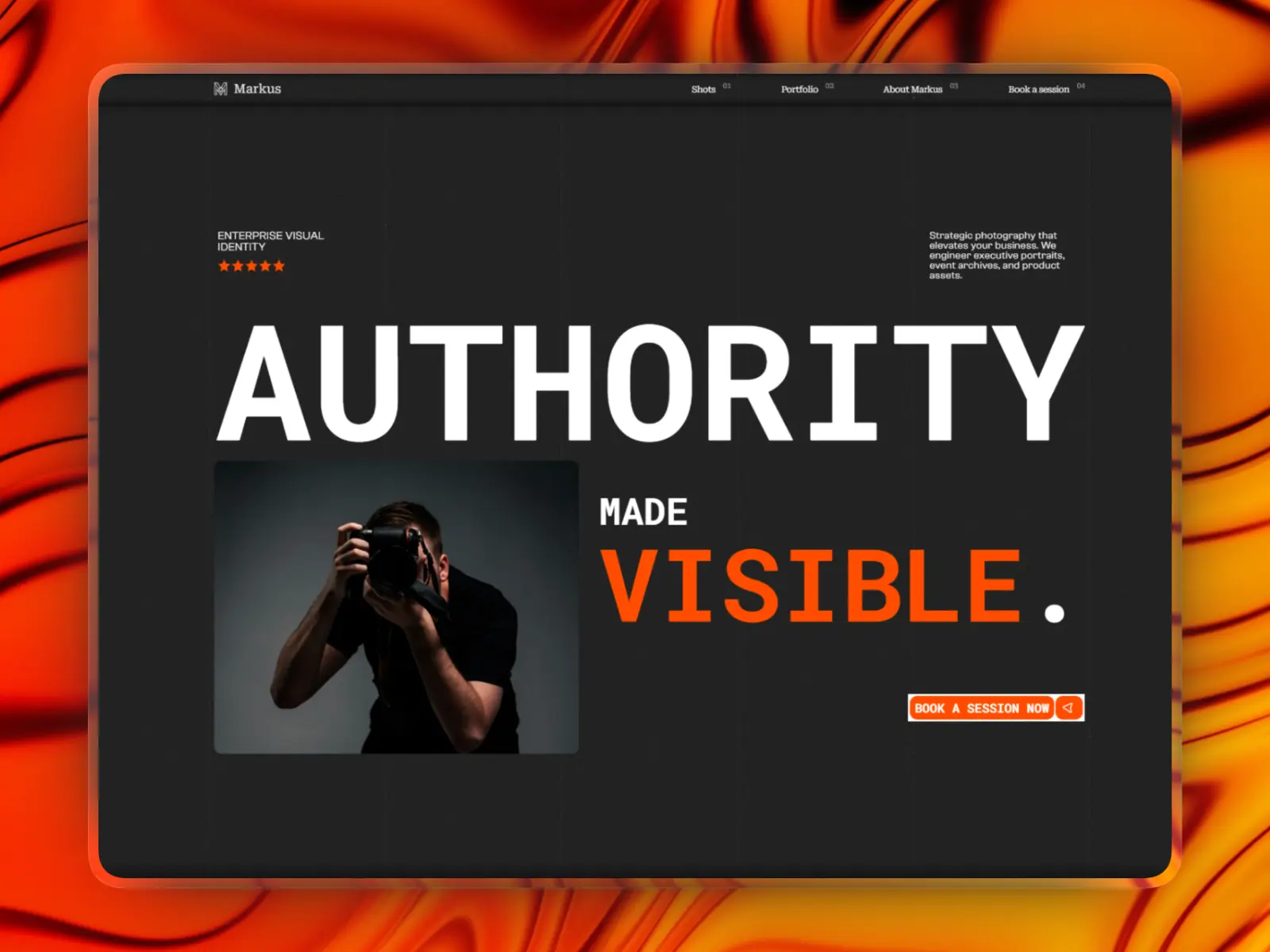
1. Hero: Authority. Made Visible.
The hero headline in this template leads with an outcome rather than a job title, immediately reframing photography as an instrument for market authority instead of a commodity service. A concise subheading introduces the creator as a strategic portrait and visual identity photographer with a proven system for engineering commercial assets, which positions them as a specialist with methodology, not a generalist with a camera.
A single, prominent call-to-action such as Book a Session anchors the hero and reduces cognitive load; CRO research consistently shows that clear, visually distinct CTAs can dramatically lift conversions versus cluttered or ambiguous options.
2. Solutions and Capabilities
Rather than listing technical services (portraits, retouching, events), the template groups offerings into conceptual solutions like Executive Brand Architecture, High-Stakes Event Coverage, Legacy Documentation, and Commercial Identity and ROI. This language speaks to business outcomes-positioning, risk management, perceived value-so decision-makers can quickly map services to their own pressures.
Copy beneath each pillar explains who the offer is for and what strategic problem it solves, aligning with marketing best practice that service pages should translate features into benefits and use cases.
3. Social Proof: Trusted to Architect Industry Leaders
A Trusted by band of recognizable logos leverages the halo effect: visitors assume that if established brands and platforms trust this creative, it is safer for them to do so as well. Short testimonial excerpts mention tangible business results, such as increases in high-ticket inquiries or successful handling of high-stakes, multi-million-dollar events, further anchoring the work in commercial impact.
Linking this section to deeper case studies also satisfies modern buyer expectations: people want to skim visual proof quickly, then dive into narrative detail when they are closer to booking.
4. The Architecture of Authority Section
The template devotes an entire section to explaining the creator's framework-moving from strategic vision to visual identity, content creation, and implementation across platforms. This functions like a mini-methodology page, signaling process maturity and making it easier for clients to imagine the engagement from first call to final delivery.
Research on portfolio sites shows that visitors are more likely to contact creatives who clearly articulate process and outcomes instead of just showing visuals, because this reduces uncertainty about how it will actually work.
5. Proof of Performance and Case Studies
Dedicated case-study tiles such as AI Startup Rebrand, Organic Skincare Activation, Unified Judicial Authority, and The Minimalist Headquarters tie each project to a recognizable business context and audience type. This aligns with guidance from photography and portfolio-platform experts who recommend grouping work by niche and scenario so potential clients can immediately see relevant examples.
Each case study should share the client type, the challenge, the visual and strategic response, and the commercial outcome (for example: increased inquiries, stronger perceived authority, successful launch), turning images into business stories.
6. Visual Archive and Galleries
Rather than dumping every image into a single gallery, the Visual Archive is curated as a grid of strongest pieces, showcasing range but keeping quality control tight. SEO and UX guides for photography portfolios consistently warn that over-large, undifferentiated galleries can slow sites down and overwhelm visitors, while curated collections feel more intentional and premium.
Thoughtful use of Framer's CMS galleries, lightboxes, and responsive grids allows creatives to maintain editorial control over their archive while keeping performance strong across devices.
7. Operational Clarity and FAQs
A structured FAQ panel addresses central concerns such as global coverage, turnaround time, creative direction, retouching scope, commercial usage rights, and availability of video services. For high-value projects, this level of operational clarity removes friction long before a sales call, which conversion-rate experts identify as a key driver of higher form submissions and better-qualified leads.
By handling these questions in collapsible sections, the template keeps the page visually clean while still acting as a self-serve knowledge base for serious prospects.
8. Final CTA: Initiate Your Visual Architecture
The closing section reframes booking as initiating your visual architecture, reinforcing that this is not a one-off photo shoot but the start of a strategic identity build. A clear CTA button, repeated from the hero, provides a familiar, low-friction path to action-mirroring CRO recommendations to keep primary CTAs consistent across the page.
Designing for Conversion in Framer
Framer's technology stack-server-side rendering, optimized bundling, image CDN, and responsive components-creates a strong technical baseline for conversion-oriented sites, with many builds achieving high Core Web Vitals scores when used correctly. Authority-focused creative sites can then layer on intentional UX patterns that reduce friction and guide visitors toward booking.
Conversion Checklist
- One clear primary CTA above the fold.
- Immediate positioning clarity: who it is for, what it solves, what to do next.
- Minimal form fields to protect completion rates.
- Mobile-first spacing, tap targets, and CTA visibility.
Key conversion practices include:
- Above-the-fold clarity: ensuring that the first viewport communicates who the site is for, what outcome it provides, and what to do next.
- Focused CTAs: using one primary action (for example, Book a Session or Request a Proposal) rather than multiple competing options.
- Simple forms: limiting inquiry forms to essential fields; studies show that reducing fields from double digits to a few can significantly increase completion rates.
- Mobile-first interactions: enlarging tap targets, limiting text input on small screens, and keeping key CTAs within thumb reach.
Framer's component system makes it straightforward to build reusable, conversion-tested sections-hero, service grid, testimonial band, case-study rail-that can be reused across pages while maintaining consistent behavior.
SEO Deep Dive for Photographers and Creatives Using Framer
Search visibility for creative professionals depends on combining sound technical foundations with strategic content and link-building. A Framer-based authority template can be tuned for strong SEO performance with deliberate work in four areas: site structure, on-page optimization, content strategy, and authority signals.
1. Site Structure and URLs
SEO guides for photographers emphasize the importance of clean, descriptive URLs and a logical site hierarchy that separates core services, portfolio categories, and supporting content. In Framer, this translates into:
- A clear page tree (for example: /, /services, /case-studies, /portfolio, /about, /contact).
- Descriptive slugs for niche pages such as /executive-portrait-photography, /brand-identity-photography, or /creative-direction-consulting.
- Internal links connecting related sections and blog posts, which help both users and search engines understand topical clusters.
Framer's built-in SEO tooling supports custom slugs, automatic sitemaps, robots.txt control, and indexing toggles, making it easy to ensure that important pages are crawlable and well-named.
2. On-Page Optimization and Copy
Many photography sites are near-invisible to search engines because they rely heavily on images with minimal text; SEO specialists stress that search engines cannot rank what they cannot read. An authority-oriented Framer template counteracts this by embedding high-quality copy throughout the layout.
Best practices include:
- Writing unique, keyword-informed page titles and meta descriptions for every core page.
- Using H1 and H2 headings that combine creative language with specific service descriptors (for example: Authority-Building Portraits for Founders in Berlin).
- Adding short, descriptive introductions to galleries and portfolio sections that naturally include niche and location terms.
- Providing image alt text that describes subject, style, and context instead of generic labels, balancing accessibility with SEO.
3. Content Strategy and Topical Authority
Guides aimed at photographers repeatedly highlight that sustained blogging and educational content are among the most effective ways to build topical authority and attract organic traffic. For an authority-focused creative brand, this might include articles on:
- How to prepare for executive portrait sessions.
- How brand photography affects perceived pricing power.
- Case-study breakdowns of successful rebrands or campaigns.
- Location-focused guides such as where to shoot authority-building portraits in Frankfurt.
Publishing in-depth, first-hand content on topics directly related to the services offered aligns with Google's emphasis on E-E-A-T and helps establish the creator as the go-to expert for that niche.
4. Authority Signals and Backlinks
Backlinks-links from other relevant, reputable sites-remain a strong signal of authority in search algorithms, and photography-specific SEO resources encourage creatives to seek placements in publications, blogs, and vendor sites. Practical options include:
- Submitting work to niche blogs, awards, and magazines.
- Collaborating with agencies, venues, or brands that list preferred partners on their sites.
- Guest-writing educational posts on creative or business blogs in exchange for a byline link.
By housing case studies and educational content on a well-structured Framer site, creatives give potential link partners strong pages to reference, increasing the likelihood of organic mentions over time.
Creative Positioning: Beyond Photographers
Although the reference template is built around a strategic portrait and visual identity photographer, its architecture generalizes well to other creative professions: brand designers, creative directors, copywriters, studios, and consultants. The common thread is a focus on high-value, consultative work where clients care about thinking and process at least as much as deliverables.
Non-photographic creatives can adapt the same structure by replacing visual identity language with their own discipline, adjusting case-study categories to match typical projects, and retaining authority-centric headlines that speak to market impact rather than tools.
Implementation Playbook: Turning a Template into a High-Performing Asset
To transform an authority-focused Framer template into a live site that both ranks and converts, creatives can follow a phased implementation plan.
Execution Snapshot
- Phase 1: clarify audience, promise, and solution language.
- Phase 2: adapt structure, rewrite copy, and curate only relevant work.
- Phase 3: finalize SEO, mobile UX, image optimization, and analytics.
- Phase 4: publish, measure behavior, ship content, and earn backlinks.
Phase 1: Strategic Foundations
- Define audience and niche: specify exactly who the site should attract.
- Clarify core promise: distill the value proposition into a short phrase that captures the outcome, not the activity.
- Map services to outcomes: translate internal service lists into named solutions that address concrete problems.
Phase 2: Content and Structure in Framer
- Install the template and review all existing sections so nothing valuable is left unused.
- Rewrite every section in the brand's own voice while preserving structural intent.
- Curate a tight portfolio aligned with the new positioning; remove legacy work that confuses the niche.
- Build category pages in Framer CMS for key project types, each with its own copy and SEO focus.
Phase 3: Technical and SEO Optimization
- Set up SEO basics in Framer: custom meta titles and descriptions, indexability settings, and clean URL slugs.
- Optimize images by compressing, using modern formats, and adding descriptive alt text.
- Ensure mobile excellence by testing layouts, tap targets, and CTA visibility on small screens.
- Connect analytics and search tools to monitor performance, impressions, and query data.
Phase 4: Launch, Learn, and Iterate
- Publish the site and request indexing of critical pages via Search Console.
- Monitor behavior metrics like bounce rate, time on page, and form submissions.
- Add educational content steadily to grow topical authority and internal linking opportunities.
- Pursue backlinks by pitching work to relevant blogs, directories, and partners.
Over a period of months, this cycle compounds: as more authoritative content and links accrue, rankings rise, traffic grows, and the authority narrative becomes self-reinforcing.
Conclusion
An authority-building website for photographers and creative professionals is not a matter of ornamentation; it is the deliberate design of narrative, structure, and proof around a clear promise. Studies on first impressions confirm that design quality and clarity within the opening seconds strongly shape whether a site is trusted and used, making premium, cohesive visuals non-negotiable.
Framer provides a technically strong foundation-server-side rendering, performance optimization, and SEO tooling-while an authority-focused template supplies a proven page architecture centered on outcomes, social proof, and operational clarity. When combined with focused positioning, curated work, SEO-driven content, and consistent iteration, this structure turns a creative portfolio from a static gallery into a leverageable business asset capable of attracting, convincing, and converting high-value clients over the long term.